Where AI Actually Breaks: Operations, Data, and Everything Outside the Chat
Most AI tools work well in isolation, but break down in real operations. From Stripe to calendars, CRMs, and messy data, here’s where AI struggles, and what that looks like in practice.
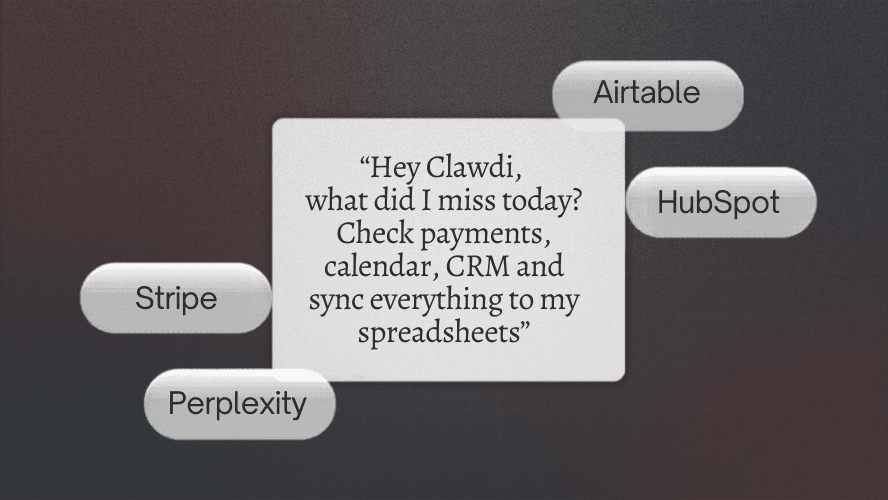
Most AI tools work well in a demo. You ask a question, get an answer, and maybe generate a document. It feels useful. But the moment the work moves outside the chat box, things start to break. Not because the model isn’t capable, but because the work itself is no longer contained in a single place. It lives across systems.
Payments Don’t Wait (Stripe)
When you’re looking at payments, you’re actually trying to answer questions like who hasn’t paid yet, what came in today, and what needs a follow-up. This is an operational task. The information is live, tied to real outcomes, and often requires immediate action. AI can summarize a report, but actually working with payments means connecting data, context, and next steps.
Time Is Fragmented (Calendar)
Your day is beyond a clean schedule. It’s a mix of meetings that need preparation, context scattered across messages and docs, and follow-ups that happen after the call ends. AI can help you draft an agenda. But the real work is more like pulling together everything related to a meeting, understanding what matters going in, and making sure something happens afterward. That doesn’t live in one place.
Relationships Need Attention (CRM)
A CRM like HubSpot doesn’t fail because it lacks information; it fails because no one knows who needs attention right now, what was said last, and what the next step should be. AI can generate a follow-up message and help you send it, but knowing who to follow up with and why requires pulling together history, context, and current state across conversations and deals.
Data Is Messy (Airtable)
Real work lives in half-updated rows, inconsistent formats, and fields that only make sense to the person who created them. AI is good at summarizing structured information. But most operational data isn’t structured in a way that’s ready to use. The problem isn’t just understanding it. You need help with navigating it.
Answers Aren’t the Same as Action (Search)
Tools like Perplexity are great at researching and answering questions. You can ask what something means, how something works, and what the best option is. And you’ll get a pretty good answer. But in most workflows, the answer is only the first step, because you still need to apply it to your context, connect it to your tools, and turn it into something that actually moves work forward. That’s where things break.
Here Comes The Pattern
Across all of these, the issue is that the work doesn’t live in one place. It’s spread across systems, tied to real-time data, and often requires action, not just understanding. AI works well when the task is contained. It struggles when the work is connected.
Where This Leaves Us
This is the gap tools like Clawdi are trying to close. Not by replacing the tools you already use, but by connecting them in a way that reflects how work actually happens. And this is still early. But if AI is going to be useful beyond demos, it has to move beyond the chat box and into the messy, operational parts of work.
AI feels useful when the problem is simple. It becomes valuable when it can handle the parts that aren’t.
Clawdi is a tool designed to organize your workflow and save you time across the apps you use every day. It's more than just an AI assistant.
But don't just take our word for it, listen to the people who are already using it and see how it fits into real workflows.
If you have any feedback or thoughts, send us a message on Twitter/X or LinkedIn. We're all ears. And we'd love to hear how you use Clawdi.