Multi-Agent Systems with OpenClaw: Architecture, Orchestration, and Production Deployment
Learn how to design and deploy multi-agent systems with OpenClaw: coordinator-worker patterns, context routing, memory strategy, failure recovery, and production operations.
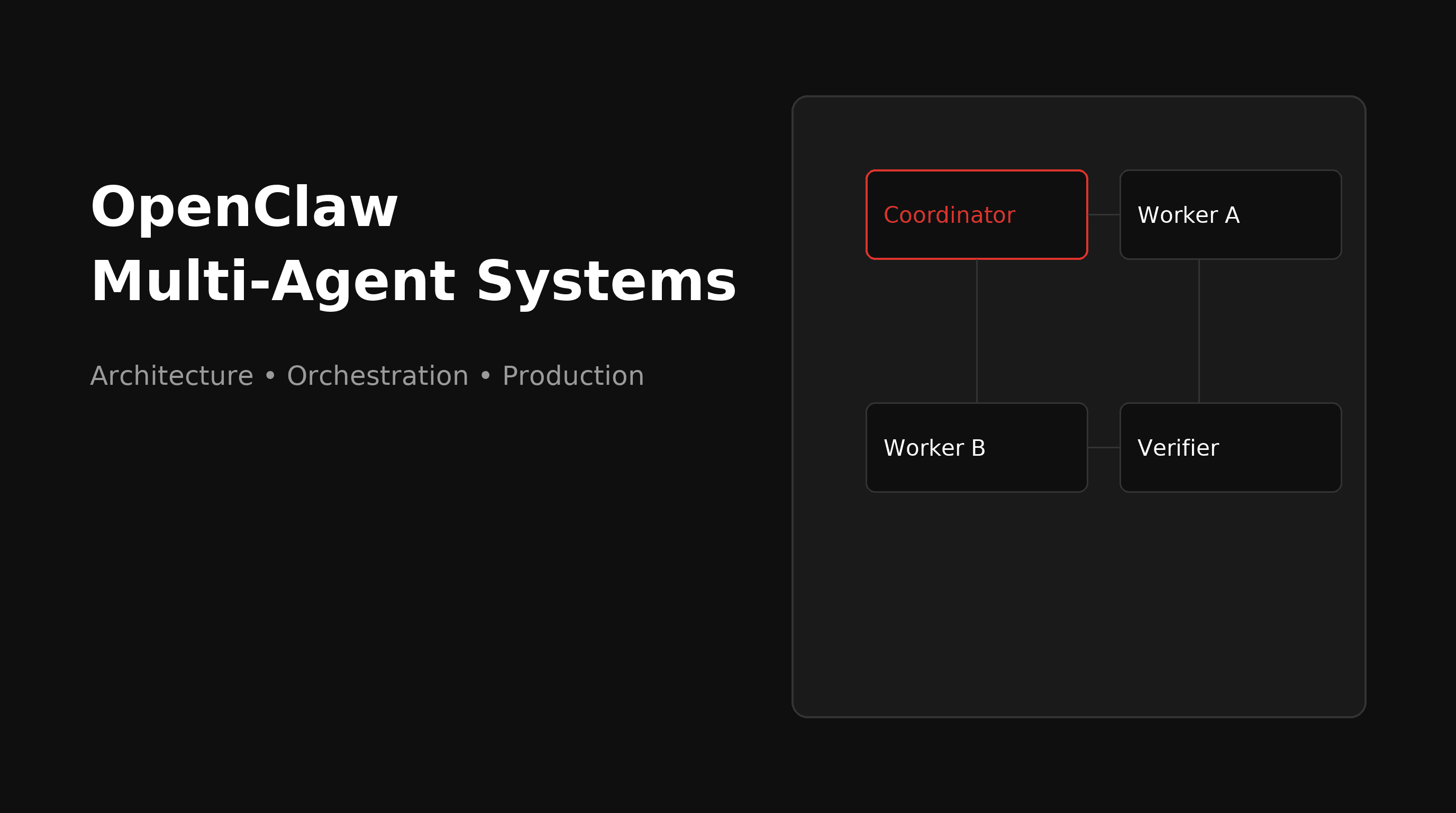
Multi-agent AI is where interesting systems start to happen.
A single assistant can answer questions. A multi-agent system can run real workflows: plan, delegate, execute, verify, and recover when things break.
OpenClaw is a strong foundation for this because it already has the pieces most teams struggle to wire together: tool access, memory, session continuity, and channel-native operations.
This guide is a practical architecture playbook for building production multi-agent workflows with OpenClaw.
What “multi-agent” means in production
A production multi-agent system is not just “many bots chatting.”
It has explicit roles:
• **Coordinator agent**: receives user intent, decomposes tasks, sets guardrails
• **Specialist agents**: execute domain tasks (research, coding, ops, content)
• **Verifier/critic agent**: checks outputs against constraints and quality bars
• **Operator loop**: handles approvals, retries, and escalation paths
The outcome is reliability and throughput, not novelty.
Core architecture patterns
1) Coordinator-Worker (default)
Coordinator decides work units, workers execute in parallel, coordinator merges results.
Use when:
• tasks are decomposable
• speed matters
• partial failure is acceptable
2) Planner-Executor-Reviewer
Planner creates a plan, executor runs, reviewer validates against rubric.
Use when:
• output quality matters more than latency
• work needs deterministic validation
3) Event-Driven Specialist Mesh
Agents subscribe to event types (new lead, incident, payment failure, support ticket).
Use when:
• workflows are continuous
• ops and monitoring are core
Context and memory routing strategy
Multi-agent systems fail when context is either too broad or too fragmented.
Use this split:
• **Global memory**: shared policies, org context, canonical references
• **Role memory**: specialist-specific playbooks and constraints
• **Task memory**: ephemeral working context for one job
Rules:
• Keep shared memory small and curated
• Pass only task-relevant context to workers
• Persist final decisions, not every intermediate thought
Orchestration checklist for OpenClaw
1. Define agent roles in clear capability boundaries
2. Set explicit handoff schema (input/output contract)
3. Add timeout + retry policy per role
4. Add verifier gate before external actions
5. Log run metadata for audit/replay
6. Add human-approval checkpoints for sensitive actions
If you skip steps 2 and 4, quality will drift fast.
Failure modes (and how to harden)
Context drift
Symptom: worker outputs become inconsistent over time. Fix: tighter task packets, smaller role memory, stronger output schema.
Tool-call flakiness
Symptom: intermittent execution errors across agents. Fix: idempotent retries, circuit breaker thresholds, fallback routes.
Feedback loops
Symptom: agents keep delegating to each other. Fix: max-hop limits, coordinator-only delegation policy.
Silent quality regression
Symptom: throughput rises but business outcomes fall. Fix: verifier agent + KPI-linked acceptance tests.
Observability that actually matters
Track these per workflow:
• task success rate
• median/95p completion time
• retry count per role
• verifier rejection rate
• cost per successful task
• human intervention rate
These six metrics are enough to detect most system degradation early.
Cost control for multi-agent workflows
Multi-agent can burn budget fast if unconstrained.
Controls:
• route high-volume steps to cheaper models
• reserve premium models for planner/reviewer or edge cases
• cap max tool calls per task
• terminate low-confidence loops early
Your north-star is cost per accepted output, not tokens alone.
Reference implementation blueprint
A practical production chain:
1. User request enters coordinator
2. Coordinator creates 2–4 work packets
3. Specialists run in parallel
4. Verifier scores each output
5. Coordinator merges + resolves conflicts
6. Human approval (if required)
7. Final action + memory write + run summary
This pattern scales from content pipelines to support operations and GTM workflows.
Where Clawdi fits
If you want multi-agent outcomes without spending your team on infra glue, Clawdi provides the faster path: deploy OpenClaw workflows, manage operations, and iterate on orchestration logic instead of rebuilding runtime plumbing.
Final takeaway
Multi-agent systems are not about adding more agents. They are about designing clear roles, strict contracts, and reliable recovery paths.
With OpenClaw, you can ship this architecture now. With the right orchestration and ops discipline, multi-agent stops being a demo and becomes an execution engine.