
Your Next Hire Is an AI Assistant, Not Another Ops Person
Most SaaS teams don’t need another ops or marketing hire—they need a persistent AI assistant that actually owns work across inbox, calendar, analytics, and playbooks.
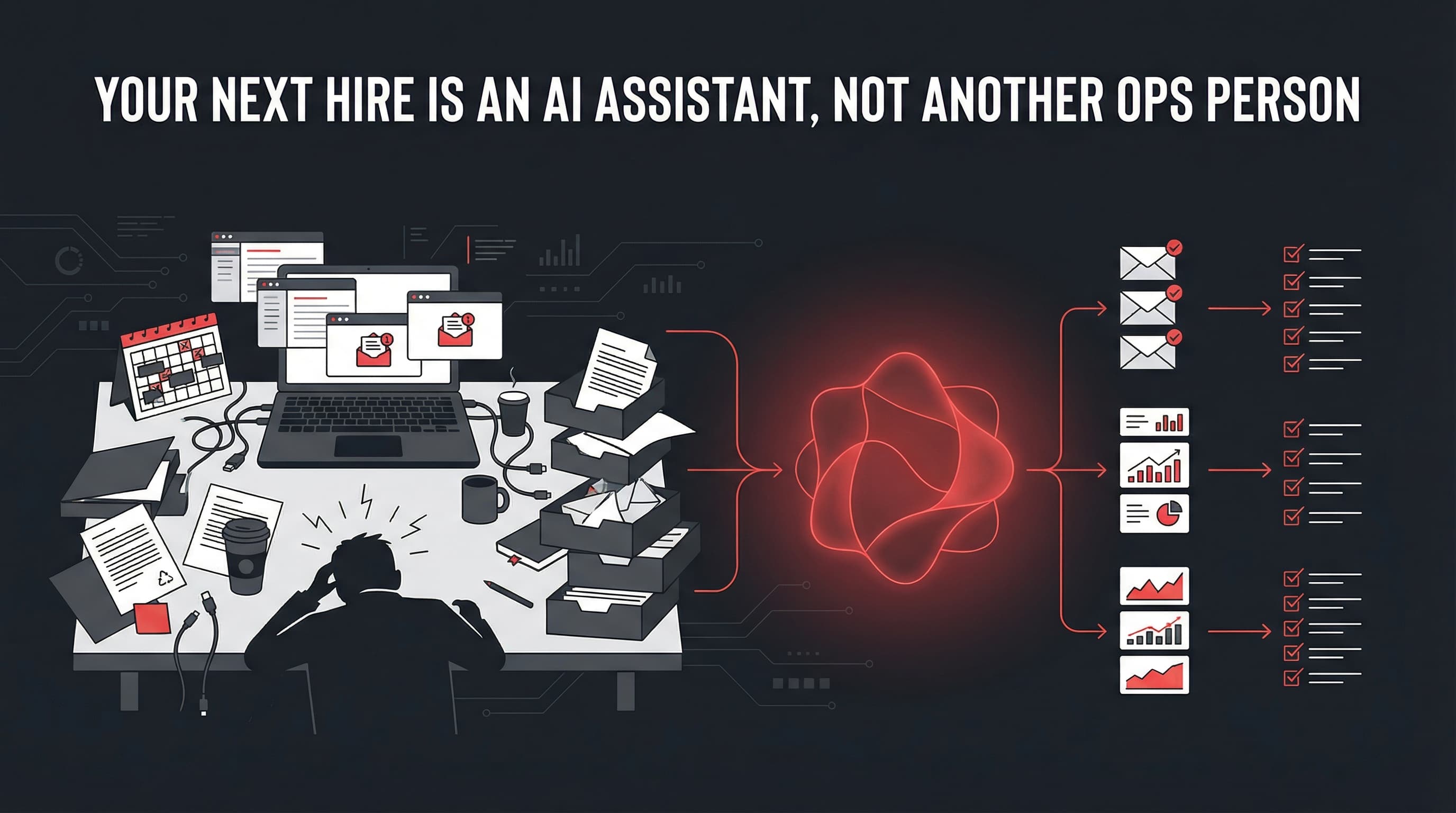
We’re still hiring humans for work an AI assistant can already own
Most teams try to hire their way out of the same problems:
- “We need someone to stay on top of support and the inbox.”
- “We need someone to pull metrics every week.”
- “We need someone to keep our docs and CRM up to date.”
Look closely and a big slice of that workload is:
- Repetitive
- Process-driven
- Tool-based (Gmail, Slack, HubSpot, Metabase, Notion…)
Exactly the kind of work you can offload to a persistent AI assistant that lives in your tools and has access to your data.
The mental shift is simple but deep:
Don’t add another ops headcount until you’ve hired a real AI assistant.
This post walks through what that looks like in practice, and where Clawdi fits.
“Assistant as teammate” vs “chatbot as toy”
Most AI usage today still looks like this:
- Open ChatGPT or a random chatbot
- Paste context
- Get an answer
- Close the tab
- Repeat tomorrow
That’s not an assistant. That’s a smarter search box.
A real teammate‑style assistant is different:
- It lives where your work happens
- Slack / Discord / Telegram
- Email and calendar
- Analytics, docs, CRM
- It has memory and state
- Remembers projects, naming, customers
- Knows what happened last week and what it already did
- It owns ongoing responsibilities
- Pulls metrics on a schedule
- Cleans the inbox and drafts responses
- Updates docs and sends follow‑ups after releases
That’s the model Clawdi is built around: managed, persistent OpenClaw assistants deployed on your own infra, not another browser tab you forget about.
Three categories of work your AI assistant should own

If you had to “hire” one AI assistant today, what should you hand off?
1. Inbox and calendar hygiene
For founders and small teams, this is the first sinkhole:
- Emails go unanswered
- Calendar invites are scattered
- Follow‑ups are inconsistent and manual
A Clawdi‑style assistant can:
- Watch your inbox
- Summarize threads
- Flag important messages
- Draft replies in your voice for approval
- Manage your calendar
- Propose slots
- Draft agenda summaries
- Nudge you on prep and follow‑ups
This is exactly what a junior ops hire would do. A well‑tooled assistant does it without onboarding cost or churn risk.
2. Reporting and analytics
Every startup has the same recurring analytics work:
- Weekly “how are we doing?” metrics
- Campaign performance summaries
- Ad spend vs revenue breakdowns
- Funnel conversion trends
Instead of a human stitching Metabase, GA, PostHog, and ad platform screenshots into Notion, your assistant can:
- Hit your Metabase / GA4 / PostHog APIs or dashboards
- Pull key KPIs on a schedule (e.g. every Monday 9 AM)
- Generate:
- A short executive summary
- A table of core metrics (MRR, WAU/MAU, activation, trial→paid, CAC/LTV)
- Notes on significant changes vs last week
Delivered straight into your founder channel in Slack or Telegram.
With Clawdi, this looks like a “Growth Analyst” assistant configured with:
- Access to Metabase, GA, PostHog
- A simple reporting template
- A cron or heartbeat schedule
…and it just shows up with your weekly report.
3. Routine playbooks and content ops
The third category is everything you *know* you should do, but never quite get to:
- Follow‑up emails after calls and demos
- Customer check‑ins at day 3 / 7 / 30
- Blog outlines, tweet threads, LinkedIn posts
- Internal docs and changelog updates after releases
Your assistant can:
- Watch for events (new signup, upgrade, churn)
- Draft responses:
- “Welcome + onboarding tips” messages
- “You haven’t tried feature X yet” nudges
- Propose content:
- Weekly LinkedIn posts based on product changes
- Monthly newsletter drafts using metrics + product updates
The human stays in the loop (approve/deny/edit), but the assistant does the heavy lifting.
Why this only works with a persistent assistant
You *can* duct‑tape pieces of this with a generic chatbot and a pile of scripts:
- A cron here
- A Zap there
- A script that hits an API and drops text into Slack
You end up with:
- No single mental model: “Who’s responsible for X?”
- No memory: stateless, brittle automations
- No owner: everything is “nobody’s job” when it breaks
A persistent assistant has:
- Identity: one agent per role (e.g. ops-assistant, marketing-assistant, founder-cos)
- Tools: a defined set of skills (email, calendar, analytics, docs, CRM)
- Memory: its own workspace, notes, and logs
- Schedule: heartbeat/cron to run recurring tasks
That’s radically easier to reason about than ten scripts and five SaaS automations owned by nobody.
Where Clawdi fits
Clawdi gives you:
- Managed OpenClaw – you don’t manage agent infra
- Per‑assistant workspaces – each with its own skills and memory
- Access to your tools through Composio, Metabase, etc.
- Private deployment – assistants run on your own Phala CVM with your keys
Instead of standing up infra, wiring GA/PostHog/email/Slack integration by hand, and maintaining scripts, you define:
- A founder assistant with Gmail, Calendar, Slack access and:
- Weekly metrics report skill
- Inbox triage skill
…and Clawdi’s managed environment keeps it running close to your data.
How to pilot this instead of hiring
If you’re on the fence between “hire an ops/marketing generalist” vs “spin up an assistant,” run this experiment:
- Pick one role to “hire” an assistant for
- Founder’s chief‑of‑staff
- Growth / marketing ops
- Customer success
- List 3–5 recurring responsibilities
- Things that happen every week/month and can be described as a checklist
- Implement those as a Clawdi assistant
- Give it the right tools (email, calendar, analytics, CRM, docs)
- Give it a schedule (heartbeats / crons)
- Route its output into your main channels (Slack / Telegram)
- Run for 30 days and measure
- Hours of human time saved
- Quality of outputs (reports, drafts, follow‑ups)
- Number of tasks it owns end‑to‑end
If after 30 days it’s still doing real work for you, you know you can delay or reshape your next hire. The assistant covers the glue work—your humans can do the uniquely human parts.